

Student meal delivery UK: how to choose convenient home-cooked meals on a budget
Saakshi's Kitchen EditorialKey Takeaways
Choosing student meal delivery in the UK is mostly about fit: the right postcode, storage space, budget and flavours can make the difference between a useful food order and an expensive box left untouched.
- Check delivery coverage, lead times and minimum order values before paying.
- Confirm whether meals arrive frozen and whether your accommodation has suitable freezer space.
- Compare the real cost per serving with takeaway food and supermarket alternatives.
- Read ingredient, allergen, spice and halal information carefully.
- Choose a provider with clear kitchen, packaging, support and refund information.
What to look for in student meal delivery
A good student meal service should fit around lectures, part-time work and the realities of shared accommodation. The phrase student meal delivery UK covers several different arrangements, from ready-to-reheat dishes to planned weekly boxes, so the label alone tells you very little. Start with practical details rather than glossy menu photographs. A service is only convenient if it can reach your university, fit into your freezer and suit the amount of cooking you actually want to do.
Delivery coverage for your university and postcode
University addresses can be surprisingly awkward for deliveries. Halls may have reception desks, restricted vehicle access or rules about food parcels, while a private house or flat may use a different postcode from the campus itself. Enter the full delivery postcode before ordering and check whether parcels go to the door, a collection point or a nominated day slot.
It is also worth checking the provider’s delivery area page rather than assuming that “UK delivery” includes every location. A useful student delivery checklist can help families think through address details, delivery coordination and the practicalities of sending meals from home.
Frozen, frozen and ambient meal formats
Meal format affects almost everything that follows: storage, delivery timing, reheating and waste. Frozen meals usually give students more flexibility because they can be stored until needed, whereas ambient products may have different handling instructions and a shorter or longer cupboard life depending on the food.
Read the label for storage temperatures, use-by guidance and whether a meal can be reheated from frozen. Do not rely on the appearance of the parcel alone. The kitchen instructions should make clear what to do as soon as the order arrives.
Portion sizes and meal variety
A single serving can mean different things between providers, so look for the stated weight or a clear description of what is included. Is it one curry, or a complete meal with dal, rice, roti or a vegetable side? Students often need a mixture of quick lunches, filling evening meals and smaller options for days when plans change.
Variety matters too, particularly if an order covers several weeks. A rotating menu may include vegetarian dishes alongside meat-based meals and familiar options such as rajma chawal, chole, kadhi or dal tadka. If you are comparing services, a guide to portion sizes and meal plans gives you a useful set of questions to take to the menu page.
Reheating equipment and preparation time
A microwave is common in student housing, but wattages vary and some accommodation kitchens have limited counter space. Check whether the container can go in the microwave, whether the film should be pierced or removed, and whether a hob or oven is needed. Instructions that take five minutes in one kitchen may be inconvenient if you are waiting for a shared appliance.
Look for preparation times that match your routine, not an idealised Sunday afternoon. The simplest service is usually one with clear reheating steps and portions that do not require extra pans, chopping or washing up.
How student meal delivery works
Most services follow a straightforward pattern: choose meals, select a delivery option, receive the parcel and store it correctly. The small details sit between those stages, especially for students who may be away during the day or sharing a kitchen with several flatmates. Before placing an order, map the process against your accommodation and timetable.
Choosing meals and placing an order
Menus can be arranged by dish, dietary preference, meal plan or delivery date. Take a moment to read the individual item information instead of selecting only from photographs. Check serving size, ingredients, allergens, spice description and the number of portions included in a box.
If a parent or family member is ordering for a student, agree the address and delivery contact first. A short message about freezer space can prevent an otherwise thoughtful order becoming difficult to store. For broader ideas on student meal planning, compare the number of meals ordered with the days the student is actually likely to eat at home.
Understanding delivery days and lead times
A delivery calendar may have cut-off times several days before dispatch. That matters at the start of term, around examinations and when a student moves between halls and private accommodation. Keep the confirmation email and check whether delivery dates can be changed after payment.
Some students prefer one larger order, while others want smaller deliveries that take up less freezer space. Either approach can work, but only if the order arrives when somebody can receive it and there is a clear plan for putting meals away.
Storing meals safely in student accommodation
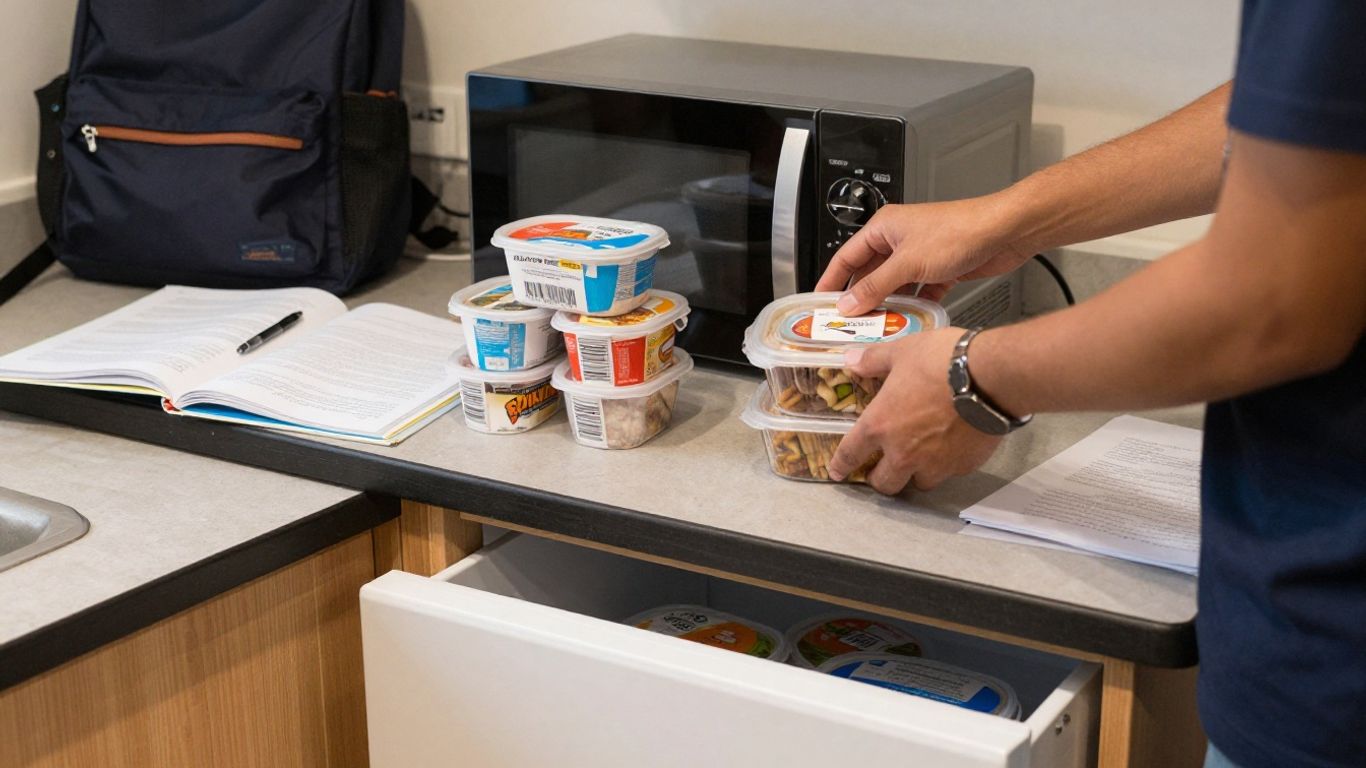
Freezer capacity is often the limiting factor in halls. Measure the available drawer or shelf before ordering, and remember that flatmates may already be using part of it. Once the parcel arrives, follow the provider’s storage instructions and avoid leaving frozen food sitting out while you sort the rest of the delivery.
A simple routine helps when several meals arrive together:
- Photograph the labels before putting meals away.
- Group dishes by the date you expect to eat them.
- Keep the reheating instructions somewhere easy to find.
- Leave enough room for air to circulate around the stored food.
This takes only a few minutes, but it prevents the familiar problem of finding an unlabeled container at the back of a crowded drawer. If the freezer is too small, choose a smaller order or coordinate delivery with a housemate rather than forcing everything into one compartment.
Reheating meals with shared-kitchen equipment
Shared kitchens reward preparation. Take one meal out according to its instructions, use a microwave-safe plate if required, and allow standing time where the label recommends it. Microwaves can heat unevenly, so stirring or turning a dish may be part of the instructions.
Try not to guess with cooking times, especially when appliances differ. Keep a note of what worked on your particular microwave, but treat the packaging guidance as the starting point. A meal that reheats reliably is much more useful than one that needs several pieces of equipment.
Comparing the cost of student meals
Price per box is rarely the whole story. Students should add delivery charges, minimum order values, storage capacity and the cost of anything needed to complete the meal. A takeaway may look similar at checkout but can become expensive when ordered repeatedly; a larger delivered order may be cheaper per portion but harder to store.
The right comparison is personal. Count the meals you will genuinely eat, not every portion included in a promotional bundle, and allow for weeks when you travel home or eat on campus.
Cost per serving versus takeaway food
Write down the total cost of the order, including delivery, then divide it by the number of servings you expect to use. Compare that figure with a typical takeaway order and with the ingredients for a supermarket meal. This does not make one option universally cheapest; it simply shows where your money is going.
The table below is a useful framework rather than a promise of any particular price.
| Cost factor | Delivered ready meals | Takeaway food | Supermarket cooking |
|---|---|---|---|
| Cooking time | Usually limited to reheating | None at home | Varies by recipe |
| Delivery cost | Check the provider’s terms | Often added per order | Usually not applicable |
| Storage need | May require freezer space | Usually eaten immediately | Depends on ingredients |
| Portion planning | Count individual servings | Often ordered by dish | Controlled by the cook |
The cheapest-looking column can change from week to week. A student who often buys takeaway after a late seminar may value predictable portions, while someone who enjoys cooking may prefer to spend less on ingredients and more time in the kitchen.
Subscription plans and one-off orders
Subscriptions can make meal planning easier, but they should be treated as a commitment rather than an automatic saving. Check how often deliveries repeat, whether meals can be changed, and how much notice is needed to pause or cancel. One-off orders may suit students with irregular term schedules or limited freezer space.
Families sometimes prefer a recurring arrangement because it removes one weekly task. Students may prefer control over each order. Neither choice is automatically better; the useful option is the one that matches the academic calendar and the student’s actual appetite.
Delivery fees, minimum order values and discounts
Read the checkout summary before confirming payment. Look for delivery charges, minimum basket values, introductory pricing, student discounts and any conditions attached to them. A discount that applies only to a first order should not be used to estimate the cost of every later delivery.
For more general ideas on finding student food discounts, check the terms carefully and compare the final amount rather than the headline percentage. Also consider whether a minimum order encourages you to buy more food than you can store or eat.
Planning orders around term dates and holidays
University calendars are full of gaps: reading weeks, Christmas, Easter, placements and short trips home. Place orders around the days the student will actually be in the accommodation, and update the address after a move. It is sensible to keep a small buffer, but not to fill a freezer just before a long holiday.
Parents sending food can ask the student for their examination dates and travel plans first. That small conversation is often more useful than guessing how many meals will be needed.
Finding suitable meals for different preferences
Students do not all eat in the same way, even when they share a flat or a family background. Some want vegetarian dishes most days, some prefer meat, and others need to avoid particular ingredients. A clear menu should make those distinctions visible without asking the customer to infer them from a dish name.
Vegetarian and meat-based meal choices
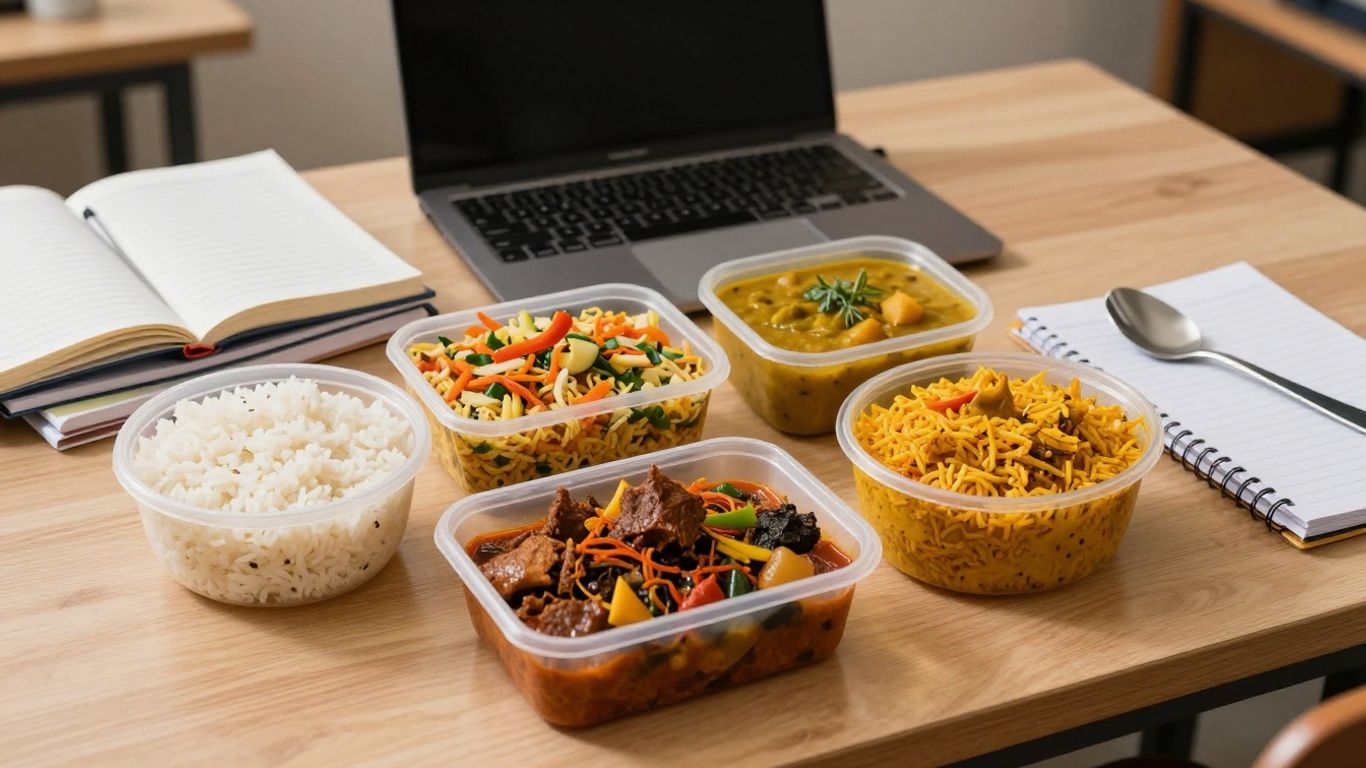
Check whether vegetarian meals are listed separately and whether a mixed box can be built from individual dishes. Meat descriptions should also be clear about the type of meat and the portion included. This is especially helpful when a family member is ordering from a distance.
A varied order might combine dal, sabzi and rice dishes with a few meat meals, rather than repeating one favourite. Students can then choose according to their plans without ordering a completely different box each time.
Checking ingredients and allergen information
Read the full ingredient and allergen information before ordering, particularly if meals are prepared in a shared kitchen environment. Ask customer support if an ingredient is unclear; do not assume that a familiar dish has the same recipe everywhere. Labels should be retained until the meal has been eaten.
This is also where wording matters. “Vegetarian”, “contains nuts” or “may contain” each carries a different practical meaning, so use the provider’s exact information when deciding what is suitable.
Understanding spice levels and regional flavours
Spice is not a single scale. A dish can be deeply seasoned without being very hot, and two versions of the same curry may differ in chilli, tang or the balance of whole spices. Look for descriptions that explain flavour as well as heat.
Punjabi home cooking often means dishes such as rajma chawal, red kidney beans with rice, or kadhi, a yoghurt-based dish with a gentle sourness. The point is not to chase restaurant intensity. It is to find food that feels natural on an ordinary evening and that the student will willingly eat again.
Halal meal options and how they are described
If halal food is required, check how the provider describes its meat and ask questions before ordering. The wording should be precise about which dishes are covered rather than implying that every item on a menu has the same status.
A family member may also want to check whether vegetarian dishes are prepared separately or whether the student has other preferences around ingredients. Clear questions at the start are kinder than discovering a problem after delivery.
Why home-cooked Indian meals can suit student routines
University life is rarely a neat Monday-to-Friday schedule. Lectures, placements, societies, shifts and long journeys can leave little patience for planning dinner. Home-cooked Indian meals can offer familiar flavours without requiring a student to begin with a full cupboard of spices and ingredients.
The most useful approach is practical rather than sentimental: order enough for the week, keep the preparation simple and choose food that fits the way the student already lives.
Managing busy lectures, placements and part-time work
A meal that can be taken from the freezer and reheated after a late finish has a different value from one that needs a shopping trip first. It can also reduce the temptation to make every tired evening a takeaway evening. The choice still needs to fit the student’s budget and storage space.
Think about the hardest days of the week. Two or three dependable meals for late nights may be more useful than a large box that looks impressive but requires careful planning.
Building a practical weekly meal plan
Start with the timetable, then add meals around the days when cooking is realistic. A simple plan could include a couple of individual portions, one larger shared meal and a flexible option for an evening that changes at short notice. Keep breakfast and lunch separate from the delivered meal budget if they are paid for differently.
A simple dinner inspiration guide can help when deciding how much variety is realistic. The goal is not a perfect menu. It is a week that leaves fewer decisions to make when the student is tired.
Keeping familiar food available away from home
Familiar food can make an unfamiliar room feel a little more settled. Punjabi home cooking, with dishes such as dal tadka, chole and baingan bharta, brings the rhythm of a family kitchen into a student routine without turning every meal into an occasion.
Saakshi's Kitchen provides home-cooked Indian meals prepared in a FSA 5-star kitchen and delivered frozen, ready to reheat. The distinction matters: this is food intended for ordinary meals at home, not a restaurant-style sharing platter.
Ordering meals for students from family members
Parents and relatives can order on a student’s behalf, but the student should still have a say in dishes, spice and delivery dates. Ask what is already in the freezer, confirm the accommodation address and choose a delivery day when someone can receive the parcel.
A family order works best when it feels like support rather than a surprise obligation. A short menu conversation can cover preferences, allergies, storage and how many meals the student actually wants.
Choosing a reliable meal delivery provider
Reliability is more than a parcel arriving once. It includes clear instructions, consistent communication and a sensible process when something goes wrong. Students may be ordering for themselves, while parents are often trying to judge a kitchen from several hundred miles away.
Look for evidence that is specific and checkable. Vague promises about quality are less useful than a stated kitchen location, clear storage guidance and customer support that explains what happens after an issue.
Reviewing hygiene and kitchen information
A provider should tell you where meals are prepared and give appropriate information about its kitchen practices. Saakshi's Kitchen operates from a FSA 5-star kitchen with an FSA 5-star rating. That is a concrete detail to look for when comparing a provider, rather than a general claim that a service is professional.
Also check that the food description matches the actual product. If meals are frozen and ready to reheat, the storage and reheating instructions should say so plainly.
Checking customer feedback and delivery records
Reviews can reveal whether delivery communication, portion descriptions and customer support match the menu promise. Look for patterns across many reviews rather than relying on one dramatic comment. Recent feedback is particularly useful if delivery areas or ordering systems may have changed.
You can also ask how missed deliveries, damaged parcels or address changes are handled. A provider that explains the process before purchase is easier to deal with when a student’s timetable shifts.
Assessing packaging and freezer suitability
Packaging needs to protect the meals during transit and remain manageable in a student kitchen. Check dimensions where available, consider how many containers fit in the freezer and find out how packaging should be disposed of. A box that technically fits may still be awkward if the freezer drawer cannot close properly.
Keep the outer delivery information until the contents have been checked. If anything is damaged or missing, photographs and order details make a support request much clearer.
Comparing customer support and refund policies
Read the cancellation, refund and replacement terms before subscribing. Check which problems qualify for a refund, how quickly an issue must be reported and whether support is handled by email, telephone or an online form. These details matter more than a polished menu when a delivery misses a hall reception deadline.
Choose a provider whose answers are direct and whose terms are easy to find. Student meal delivery should simplify a busy week, not create a second administrative task.
Saakshi's Kitchen for students in the UK
For students and families looking for home-cooked Indian food, Saakshi's Kitchen is centred on Punjabi home cooking from a FSA 5-star kitchen. The meals are delivered frozen and ready to reheat, which suits students who need flexibility rather than a fixed mealtime. Availability still depends on the delivery address and the current ordering information, so check those details before paying.
Home-cooked Indian meals prepared in a FSA 5-star kitchen
Saakshi's Kitchen prepares home-cooked Indian meals in its FSA 5-star kitchen. The food follows the everyday logic of a family kitchen: dishes such as dal, rajma, chole and seasonal sabzi sit alongside rice, roti or other meal components according to the menu. It is a useful distinction for students who want a Tuesday-night meal rather than restaurant-style food.
The kitchen’s FSA 5-star rating gives families a specific hygiene reference when they are ordering for someone living away from home. Menu and ingredient information should still be read for each individual dish.
Frozen meals that are ready to reheat
Meals arrive frozen and are ready to reheat, so students can store portions and use them when their timetable allows. This format can be particularly practical when lectures run late or a shared kitchen is busy, provided the accommodation has enough freezer space.
Follow the instructions supplied with the order and check that the student has suitable microwave or cooking equipment. Ordering fewer meals at first can be sensible if freezer capacity is uncertain.
Student delivery coverage and ordering options
Students should enter their full postcode and review the available delivery information before choosing dishes. The ordering route may depend on the location, so do not assume that a service available in one university city follows the same schedule everywhere.
Families can also coordinate an order with the student, confirming the address, delivery day and preferred menu. The UK meal delivery locations guide is a useful starting point for checking the practical questions around delivery areas, ordering windows and freezer space.
Using student and university location pages to check availability
Location pages can help students search by city, postcode or university, but the final check should always be the live ordering journey. Confirm that the displayed area includes the exact accommodation address and that the delivery date falls within term time.
Saakshi's Kitchen also provides a route for exploring home-cooked Indian dishes delivered frozen across mainland UK mainland. Read the current menu, delivery terms and storage information together, then order an amount that the student can realistically store and eat.
Conclusion
The best student meal delivery UK choice is the one that matches a real timetable, a real freezer and a real budget. Check delivery coverage, meal format, ingredients, reheating instructions and cancellation terms before ordering, then choose portions and flavours the student will genuinely look forward to eating.
Frequently Asked Questions
What should I check before ordering student meals?
Check the delivery postcode, lead time, total price, storage requirements, portion size, ingredients, allergens and reheating instructions. It is also worth confirming what happens if nobody is available to receive the parcel.
Are frozen meals practical for university accommodation?
They can be practical when the accommodation has enough freezer space and a suitable microwave or oven. Measure the available space first, follow the storage instructions and avoid ordering more portions than can be stored safely.
Is meal delivery cheaper than takeaway food?
It depends on the provider, delivery fee, order size and how often takeaway food would otherwise be purchased. Compare the total cost divided by the servings you expect to eat, rather than comparing headline prices.
Should students choose a subscription or a one-off order?
A subscription may suit a regular term-time routine, while one-off orders can be better for changing timetables, holidays or limited freezer space. Read pause, cancellation and delivery-change terms before committing.
How can students manage different dietary preferences?
Read the full menu and allergen information, check vegetarian and meat choices separately, and ask the provider about any unclear ingredients. Do not infer suitability from a dish name alone.
What reheating equipment do students usually need?
Many ready meals are designed around a microwave, but requirements vary. Check the packaging and instructions for each meal, including the appliance type, cooking time, standing time and whether stirring is needed.
Can parents order meals for a student living away from home?
Yes, but the student should confirm the address, delivery day, freezer capacity and preferred dishes first. A short conversation about spice, allergens and portion needs can make the order much more useful.
Order home-cooked Indian meals from Saakshi's Kitchen · UK delivery locations.
Students: 15% off every order over £40
Verify once with Student Beans and 15% comes off every one-off order over £40 at checkout, for as long as you are studying. First order? Use FIRST20 for 20% off instead. One code per order, so the two do not stack.
Get the student discount → · Student meal boxes for UK students