

Diwali party food for office: a practical guide to planning a memorable celebration
Saakshi's Kitchen EditorialKey Takeaways
A successful office Diwali meal is generous, easy to navigate and considerate of different appetites and dietary needs.
- Build the menu around the event format and length.
- Combine familiar Punjabi dishes with festive snacks and sweets.
- Collect dietary information and label dishes before the day.
- Choose food that travels, reheats and serves neatly.
- Confirm portions, costs, delivery times and storage in advance.
Set the menu around your office celebration
The best diwali party food for office is shaped by the celebration itself, rather than chosen as a long list of dishes. A lunchtime buffet for 20 colleagues needs a different plan from an evening gathering with drinks, speeches and a few hours of grazing. Start with the event length, the number of guests and the space available. Then build a menu that feels festive without leaving the organiser tied to the kitchen.
Choose a balance of savoury snacks, mains and sweets
A useful menu usually has a few easy bites to begin with, two or three substantial mains, suitable accompaniments and something sweet to finish. Samosas, pakoras or tikki can make the first arrival feel welcoming, while dal, rajma or chole provide the comforting centre of the meal. Add rice, roti or naan according to the serving arrangement, then keep sweets to one or two well-chosen options rather than an entire dessert counter.
Think in textures and levels of richness as well as colour. A crisp snack, a gently spiced curry, a dal, a cooling side and a small sweet give people room to make their own plate. That variety is more useful than ordering several similar curries.
Plan portions for grazing, meals and leftovers
Portion planning is easier when you decide whether colleagues will eat a full meal or return to the buffet throughout the afternoon. For a grazing event, favour smaller servings of more dishes and keep a little extra of the most popular items. For a seated lunch, give greater weight to mains, rice and breads, with snacks acting as a welcome rather than the main event.
A simple working guide can help you compare the menu before ordering. It is not a rigid formula, but it makes gaps and excesses easier to spot.
| Event style | Menu emphasis | Portion approach | Useful extra |
|---|---|---|---|
| Short afternoon gathering | Snacks and sweets | Smaller servings with variety | More napkins and small plates |
| Buffet lunch | Mains, rice and breads | Full meal portions | One extra main or dal |
| Evening celebration | Snacks, mains and drinks | Allow for grazing over time | A little food held back |
Read the guide alongside your guest list. People with larger appetites may return for seconds, while some colleagues will only want a small plate, so a modest reserve of rice, dal or one main can be more practical than adding another elaborate dish.
Include familiar favourites alongside festive dishes
Festive food can be an invitation to try something new, but an office menu should not make every guest guess what they are eating. Put well-known choices such as samosas, dal tadka, rajma or paneer beside less familiar regional snacks, and explain each dish in a few plain words. Punjabi home cooking works particularly well here because the food is built around recognisable pantry ingredients and family-style combinations.
For colleagues who already know and love Indian food, a meal such as rajma chawal—kidney beans with rice—can feel as celebratory as a more elaborate spread. It is also worth keeping the spicing measured. Restaurant dishes can be hot; an office celebration is usually better served by food that is spiced with flavour rather than heat.
Match the menu to your event format
For a drop-in celebration, arrange food that can be eaten standing up and replenished in small batches. A seated meal can support gravies, breads and rice, while a meeting-room buffet may need dishes with lids and serving spoons that are easy to manage around laptops. If the gathering includes a presentation, plan a quiet eating window rather than asking people to balance plates during speeches.
For a larger office, Saakshi's Kitchen is one option to consider when home-cooked Indian meals, delivered frozen and ready to reheat, fit the schedule. The practical question is not simply what sounds delicious; it is whether the food suits the room, the timetable and the people attending.
Choose crowd-pleasing Diwali dishes
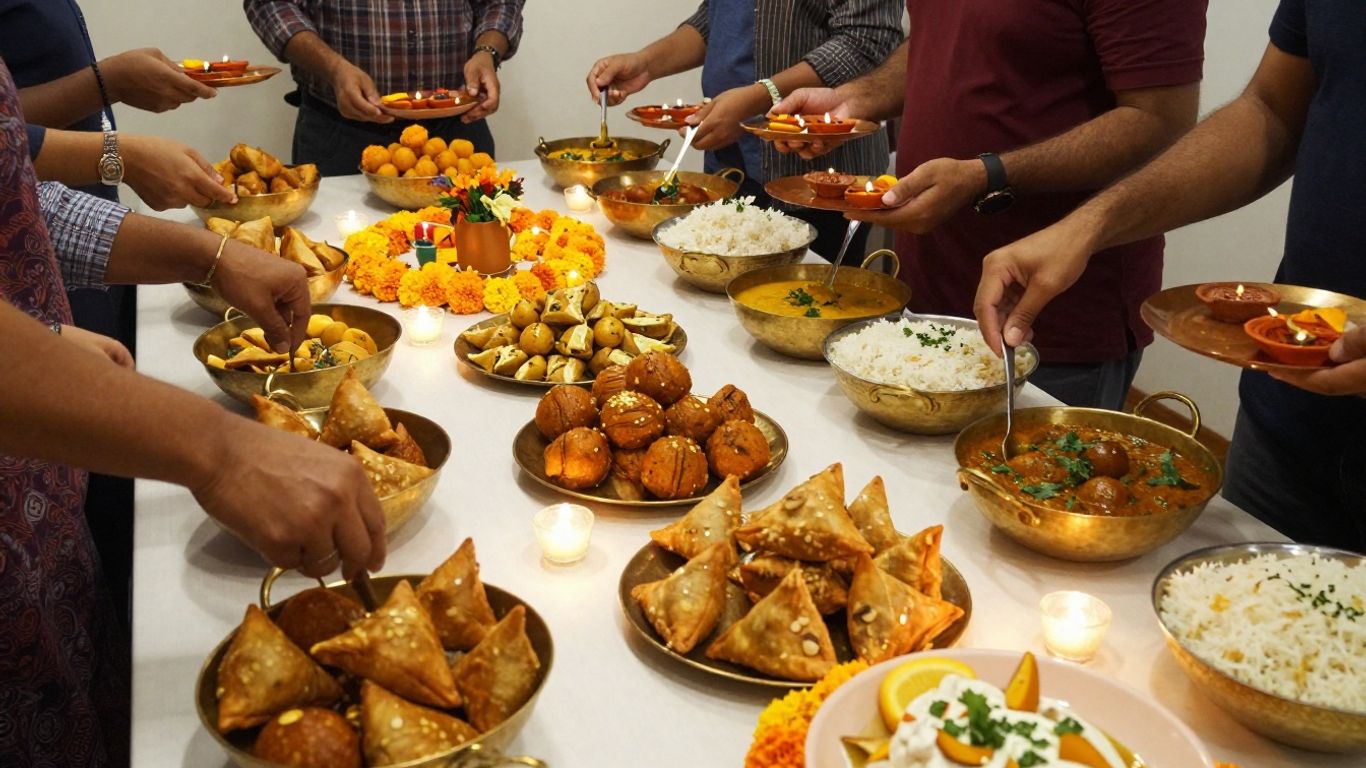
Diwali menus can be colourful and abundant without becoming difficult to serve. Choose dishes that can be portioned cleanly, hold their character for a reasonable serving period and make sense together on one table. A few carefully selected favourites will usually be remembered more warmly than a crowded buffet where everything competes for attention.
Easy-to-serve starters and finger foods
Start with bites that do not require a knife and fork. Samosas, pakoras, papad pieces, aloo tikki and small kebabs can be placed on platters with chutneys nearby, giving people an easy first plate while they settle in. Keep wet toppings separate where possible so the texture remains pleasant throughout the serving period.
A grazing board can also work well for a smaller team, with papdi, sev, spiced potatoes, chutneys and a few sweet bites arranged in sections. For more ideas, browse these Diwali snack recipes, then select only the dishes that suit your kitchen space and available serving help.
Vegetarian mains for broad appeal
Vegetarian mains should feel like a proper part of the meal, not an afterthought. Dal tadka, rajma, chole, kadhi, paneer dishes and seasonal sabzi give guests several distinct choices, especially when paired with rice or breads. Include one mildly spiced option and make the serving utensils clear so people can build a plate confidently.
Saakshi's Kitchen offers home-cooked Indian meals, with dishes such as dal, rajma and chole fitting the familiar, family-style centre of an office buffet. The meals are delivered frozen and ready to reheat, so the organiser can work backwards from the event time and allow for reheating before colleagues arrive.
Meat dishes and halal-friendly choices
If you are serving meat, choose one dish that is easy to portion and not too messy alongside the vegetarian mains. Chicken curry, a mild meat curry or a rice dish can provide variety without turning the buffet into a complicated spread. Keep meat dishes physically separate and label them plainly, even when everyone in the planning group knows what has been ordered.
Saakshi's Kitchen states that its kitchen-cooked meats are halal. That is useful information for planning, but it should still appear on the menu label so colleagues do not need to ask in front of a queue.
Traditional sweets and after-meal treats
Sweets are often the detail people associate most strongly with Diwali, so give them a deliberate place on the table. Gulab jamun, laddoo, barfi, jalebi or kheer can all work, depending on whether you want individual portions or a spoon-and-bowl service. If the meal is substantial, bite-sized sweets and fruit can be easier than a large dessert that needs cutting.
Set sweets slightly away from savoury dishes and provide small tongs or spoons. This keeps the table tidy and lets colleagues return to them later with tea or coffee rather than forcing dessert into one formal moment.
Cater for dietary and allergy requirements
Good catering makes room for different needs before food arrives, not after somebody has already filled a plate. Ask colleagues privately, record the answers in one place and pass the information to whoever is ordering or cooking. Dietary care is less stressful when the menu remains focused and the labels do the explaining.
Collect dietary information before ordering
Send a short form or message with a clear deadline, asking about vegetarian choices, allergies, religious requirements and ingredients people must avoid. Do not rely on assumptions or on a colleague speaking for a whole team. Keep the responses accessible only to the people who need them, then use them to shape the order rather than creating a separate dish for every preference.
It helps to ask whether a requirement is an allergy, an intolerance or a personal preference, while avoiding pressure for anyone to disclose more than they wish. Confirm ambiguous answers privately before placing the order.
Label common allergens clearly
Labels should name the dish, identify whether it is vegetarian or contains meat, and call out relevant allergens in straightforward language. Avoid vague descriptions such as “special sauce”, particularly where chutneys, garnishes or spice mixes are involved. Place the label beside the serving dish, not at the far end of the buffet.
Use separate serving spoons and keep packaging or ingredient information nearby when available. A colleague with an allergy should be able to make an informed choice without having to inspect every plate.
Separate vegetarian and meat dishes
Give vegetarian dishes their own section of the buffet, with dedicated serving utensils from the start. Put meat dishes at the opposite end or on a separate table if space allows. This is a small practical decision, but it prevents accidental mixing and makes the menu easier to understand at a glance.
The same principle applies to breads, rice and condiments. If anything is intended to be served with a particular dish, say so on the label rather than assuming everyone will know.
Provide suitable options without overcomplicating the menu
A manageable menu might include two vegetarian mains, one meat dish if required, a dal, rice, a bread, two starters and a sweet. That gives people choice without multiplying preparation, labelling and serving problems. Clear choices build confidence more effectively than a buffet with twenty anonymous bowls.
Before the event, make a small map of the table showing where each dish will sit. Share it with the organiser and caterer so the final layout matches the dietary plan.
Make office food easy to serve
The food may be delicious, but the celebration will feel awkward if colleagues cannot find plates, the buffet blocks a doorway or the organiser is constantly searching for serving spoons. Office rooms rarely have the generous surfaces and spare equipment of a dining room. Plan the physical movement of food, people and rubbish as carefully as the menu.
Select dishes that travel and reheat well
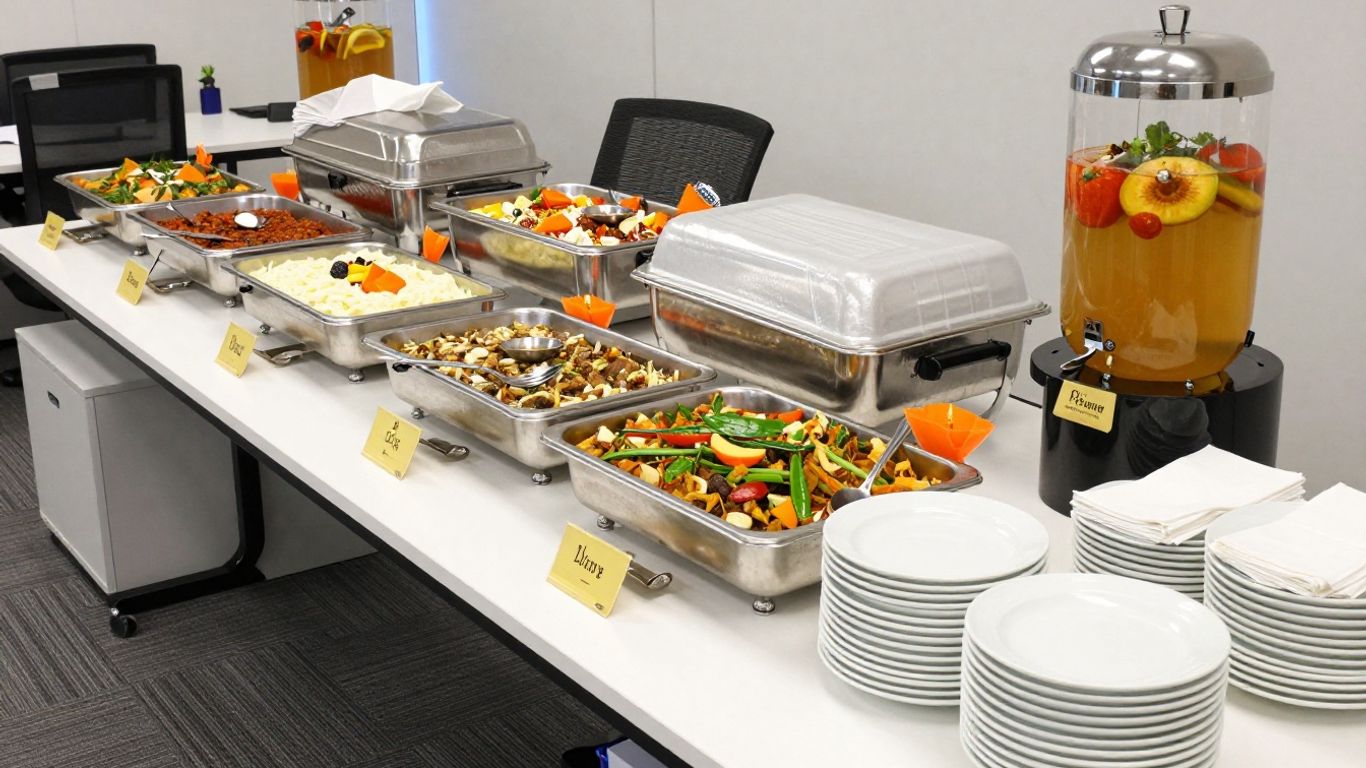
Choose curries, dals, rice dishes and dry snacks that can be moved in stable containers and reheated according to their instructions. Avoid building the menu around foods that must be assembled at the last minute unless someone has been assigned to do it. Keep sauces, garnishes and crisp toppings separate when they are likely to lose their texture.
Saakshi's Kitchen meals are delivered frozen and ready to reheat, which can suit an office that has a clear reheating window and enough appliance space. Check the instructions before ordering and avoid assuming that every dish needs the same amount of time.
Organise serving platters, cutlery and napkins
Count the practical items as well as the food. Each dish needs a serving utensil, and colleagues need plates, bowls, cutlery, napkins and somewhere to put used items. Put the first plates at the start of the buffet, then place cutlery and napkins at the end so people are not juggling them while serving.
Keep a small reserve of napkins and disposable gloves or tongs where appropriate. A spare tray is useful for carrying empty containers away without interrupting the queue.
Keep hot and cold food at safe temperatures
Follow the caterer’s storage and reheating guidance, and do not leave food sitting out indefinitely. Use suitable insulated containers, warming equipment or frozen storage as required, checking that the office has the equipment and power points available. Cold sides and drinks should have their own area rather than sharing space with hot trays.
Nominate one person to check the buffet during the event. They can replace lids, move empty trays and remind the team when food should be stored rather than left on the table.
Set up a practical buffet layout
A sensible layout creates a natural one-way flow: plates first, then starters, mains, rice and breads, sides, sweets, and finally cutlery and napkins. Place labels where they can be read without leaning over food. Leave enough space between trays for serving spoons and keep drinks on a separate table if possible.
Test the route before guests arrive. If the room has a narrow entrance, set the buffet along a wall and keep the exit clear; a little preparation prevents a festive meal from becoming a queue around the photocopier.
Plan the budget and ordering process
A clear budget protects the celebration from last-minute compromises. Start with the number of confirmed attendees, decide what the employer or organising group will cover, and include serving supplies, drinks and delivery in the same calculation. It is easier to trim a menu early than to discover after ordering that there is no allowance for plates or storage.
Estimate the cost per colleague
Divide the food budget by the number of expected guests, then add a small margin for late confirmations and larger appetites. Compare the cost of a full meal with a snack-led gathering, since the two formats can look similar on paper but require different quantities. Keep a record of tax, delivery charges and any equipment hire so the figure reflects the actual spend.
If colleagues are contributing, state the amount and deadline clearly. Nobody should have to guess whether drinks, sweets or a second serving are included.
Compare homemade, catered and delivered options
Homemade food can bring a personal touch, but it also requires volunteers, kitchen access, transport and time. Catering may reduce preparation, while delivered frozen meals can be reheated to fit the office timetable. Compare the options by labour as well as price; the cheapest invoice may still carry a high cost in organiser hours.
For a team that wants regional Punjabi home cooking without asking one person to cook for everyone, Saakshi's Kitchen can be considered as a delivered option. Check the available menu, delivery area and reheating arrangements before making the choice.
Order enough food for different appetites
Use the confirmed headcount as a starting point, but account for colleagues who will only snack, those who will eat a full meal and anyone arriving late. It is usually better to add a little more of a flexible staple such as rice or dal than to order several extra dishes that may not be touched.
Ask the supplier how portions are defined and whether dishes are packed individually or as larger containers. That detail affects both the buffet layout and the amount of food you need to order.
Confirm delivery times and storage requirements
Confirm the delivery date, time window, contact person and place where the food will be received. Then check freezer, fridge, oven and microwave capacity, along with the time needed to transfer food into serving dishes. Put these details in the event plan rather than leaving them in an email thread.
A final check two or three working days before the celebration can catch changes in attendance, access restrictions or missing equipment. On the day, keep the order confirmation and reheating instructions with the organiser.
Add festive touches without creating extra work
Festive atmosphere does not require an elaborate production. A few repeated colours, warm lighting and well-placed labels can make a meeting room feel welcoming while keeping the focus on the food and the people sharing it. Choose details that can be set out quickly and cleared away without disrupting the working day.
Use a simple Diwali-themed table setting
Choose a cloth runner, small battery-operated lights and a few marigold-coloured details rather than covering every surface. Keep decorations away from heat, food containers and walkways. If the office permits it, a small bowl of battery-operated diyas can provide a gentle focal point without creating a flame risk.
Use height sparingly. Low decorations make it easier for colleagues to see the dishes and read the labels across the table.
Add labels explaining each dish
A good label answers three questions: what is it, is it vegetarian, and what might a guest want to know before serving it? “Kadhi — yoghurt-based curry with a gently spiced gram-flour coating” is more useful than simply writing “curry”. Keep the wording short enough to read in a queue.
Add a small card for the spice level if that will help the group. Clear descriptions make unfamiliar dishes feel approachable and reduce interruptions for the person hosting.
Create a drinks pairing station
Keep drinks in one place, away from the food queue, with water available throughout. Chai, mango drinks, sparkling water and non-alcoholic spiced options can sit alongside cups, ice and a small waste bowl. If alcohol is included, provide clearly marked non-alcoholic choices as well.
A compact drinks station can be organised with just a few essentials:
- Water and one sparkling option.
- Chai or another warm drink in an insulated dispenser.
- A non-alcoholic spiced drink.
- Cups, stirrers, napkins and a clearly marked waste point.
The station works best when someone checks it once during the event, rather than when the organiser has to keep leaving the buffet. Keep the choices simple and let the food remain the centre of the celebration.
Schedule serving around activities and speeches
Tell colleagues when food will be served, especially if the event includes a welcome, a Diwali message or team activities. Put snacks out first if guests are arriving over time, then open the main buffet once most people are in the room. Leave enough time for people to eat without rushing through the social part of the celebration.
A short closing reminder about leftovers and storage helps avoid waste and makes the end of the event calmer. One named organiser can coordinate the timetable while everyone else enjoys the gathering.
Conclusion
A memorable office Diwali celebration comes from thoughtful decisions rather than an oversized order: food that suits the format, clear choices for different needs, reliable serving arrangements and a little colour on the table. Plan the practical details early, and the meal can feel generous, warm and genuinely shared.
Frequently Asked Questions
How much food should I order for an office Diwali party?
Base the order on confirmed attendance, then decide whether the event is a full meal or a grazing session. Allow a little extra of flexible staples and popular dishes, rather than adding many additional items.
What dishes work well for an office Diwali buffet?
Choose easy-to-serve snacks, two or three mains, rice or breads, a dal, a side and one or two sweets. Curries, rice dishes and dry snacks are generally easier to hold and serve than foods requiring last-minute assembly.
How can I include vegetarian colleagues?
Make vegetarian food a visible part of the main menu, not a single dish placed at the side. Label it clearly, provide dedicated serving utensils and include varied options such as dal, paneer, rajma, chole or seasonal sabzi.
How should I manage food allergies at work?
Collect information privately before ordering and ask suppliers for ingredient details where needed. Label common allergens beside each dish, keep serving utensils separate and avoid guessing about ingredients.
Should Diwali office food be spicy?
Offer a range of spice levels, with at least one mildly spiced main and clearly marked chutneys or sauces. Guests can then add heat to their own plate without making the whole menu difficult to enjoy.
What should I serve at a drop-in Diwali event?
Use finger foods, small portions, sweets and drinks that can be enjoyed without a formal sit-down meal. Replenish the buffet in batches and keep the layout simple for colleagues arriving at different times.
How far in advance should I plan the catering?
Start once you know the likely guest count and event date. Confirm dietary requirements, delivery timing, storage, reheating equipment and serving supplies several working days before the celebration, then check the final details again shortly before the event.
Order home-cooked Indian meals from Saakshi's Kitchen · UK delivery locations.