

Dal recipe questions answered: a practical guide to choosing, cooking and serving dal
Saakshi's Kitchen EditorialKey Takeaways
Dal is both a family of split pulses and the comforting dish made by cooking them with spices. These simple decisions make the biggest difference:
- Choose the dal variety according to the texture and cooking time you want.
- Rinse thoroughly, soak firmer pulses when needed, and season at the right stage.
- Cook until tender before adjusting thickness, acidity and heat.
- Use a tarka to add a final layer of aroma and character.
- Serve dal with rice or bread, then store leftovers promptly and reheat gently.
What dal is and how the main varieties differ
Dal can mean a pulse before cooking or the finished, seasoned dish in the bowl. It includes lentils, split peas and some beans, so the word covers much more than one ingredient. The best choice depends on whether you want a smooth, spoonable dal or something with a little more bite. Once that distinction is clear, dal recipe questions answered becomes a practical exercise rather than a search for one perfect formula.
Lentils, split peas and pulses explained
Lentils are small pulses that cook relatively quickly, while split peas and larger beans often need more time or soaking. Removing the skin usually makes a pulse cook faster and produce a smoother result. To see how broad the word can be, compare the simplicity of dal with a recipe built around split chana dal and bottle gourd.
The name may vary by region and household, but the useful kitchen question is simple: has the pulse been split, skinned or left whole? That tells you more about cooking behaviour than the label alone.
How red, yellow, green and black dals compare
Red lentils soften quickly and tend to melt into a thick, smooth base. Yellow dals range from delicate and creamy to pleasantly grainy, depending on the variety. Green lentils keep more shape, while whole black urad takes longer and gives a dense, rich texture.
Colour is only a starting point. Two yellow dals may behave quite differently, so look at their size and whether they are split. A darker, whole pulse normally needs more patience than a small, skinned one.
Choosing dal for creamy, hearty or lighter dishes
For a quick weeknight bowl, red lentils or split yellow lentils are forgiving choices. Use chana dal when you want a hearty texture that remains distinct, and whole black urad when the dish is meant to be slow-cooked and especially rich. A thinner dal can be made from almost any variety by adding more cooking water at the end.
Tomato, greens and a lively tarka can make a simple pulse feel complete without hiding its character. The aim is not to make every dal creamy; it is to let the chosen pulse set the mood of the dish.
When to combine different dals in one recipe
Combining dals is useful when you want both body and texture. A quick-cooking lentil can soften around a firmer pulse, while a small amount of chana dal can add gentle bite to an otherwise smooth pot. Keep the sizes reasonably close, or soak the firmer ingredient first so everything finishes together.
Start with two varieties rather than an entire cupboard. A modest blend is easier to judge, and you can adjust water after cooking instead of committing to a thick mixture from the beginning.
How to prepare dal before cooking
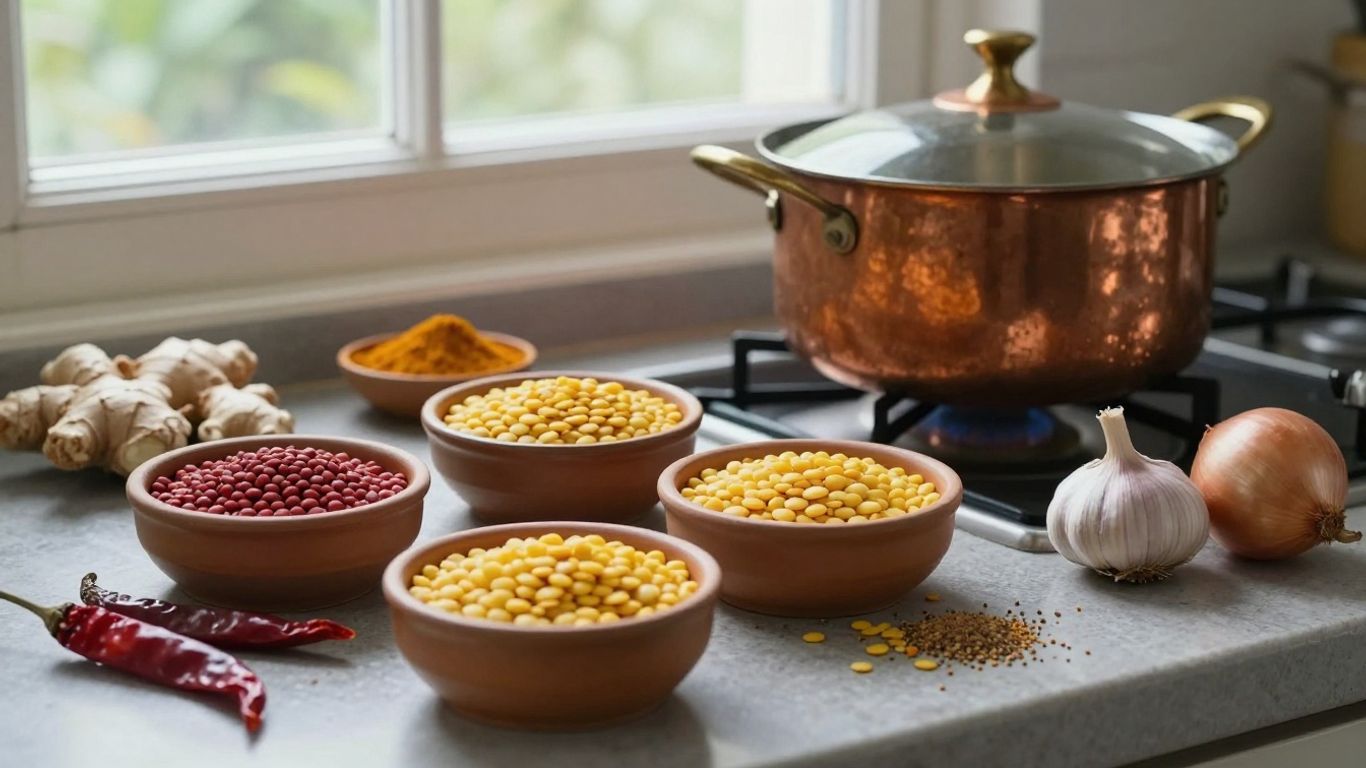
Preparation is mostly about removing dust, judging firmness and getting the flavour ingredients ready before the pan is hot. It does not need to become a separate project. A bowl, a sieve and a few minutes of chopping are usually enough. The small amount of organisation pays off when the dal begins to simmer.
Whether each type of dal needs soaking
Red lentils and many split yellow dals generally cook without soaking. Chana dal benefits from a soak, particularly when you want it tender without cooking the surrounding sauce to pieces. Whole black urad and other larger pulses may also need several hours, or an overnight soak, depending on the recipe.
Soaking is a tool rather than a rule. If you have not planned ahead, allow extra cooking time and check the water level more often.
How rinsing affects cooking time and texture
Rinse dal under cold water until the water looks less cloudy, then drain it well. This removes loose powder and helps you see any small stones or damaged pieces. Rinsing does not turn a firm pulse into a quick-cooking one, but it can help the finished pot taste cleaner and cook more evenly.
Do not leave rinsed dal sitting in a shallow puddle for hours unless you intend to soak it. Drain it, cover it with measured cooking water, or move straight to the pan.
Preparing aromatics, spices and tempering ingredients
Chop onion, ginger, garlic and tomato before cooking, and measure spices into a small dish if the recipe moves quickly. For a tarka, keep the whole spices, dried chilli and herbs beside the hob so they can be added as soon as the fat is hot. This is where ghee in cooking can be useful: a spoonful carries the aroma of spices into the finished dish.
The order matters. Hard whole spices can enter first, while delicate dried leaves or ground spices need less time to avoid scorching.
Adjusting preparation for pressure cookers and hob cooking
A pressure cooker needs enough liquid to build pressure, but not so much that the dal becomes watery. On the hob, use a roomy saucepan because foam can rise and pulses expand as they soften. A multicooker is convenient, but the release and resting time still affect the final texture.
Whichever method you use, prepare the tempering separately if you want its aroma to remain distinct. It can be stirred through at the end rather than cooked away from the start.
How to cook dal to the right consistency
Cooking dal is less about following a rigid minute count and more about reading the pot. Varieties, age, soaking and water quality all change the timing. Begin with enough liquid for the pulse to swell, then make the final texture adjustment once it is tender. That gives you control instead of guessing at the beginning.
Water-to-dal ratios for different varieties
As a broad starting point, use more water for red lentils and smooth, spoonable dals, and less for a thick mixture containing firmer pulses. Chana dal often needs enough liquid to soften fully without becoming soup. Whole pulses may require both extra water and extra time.
These are useful starting points, not fixed laws:
| Dal type | Starting approach | Likely texture |
|---|---|---|
| Red lentils | Generous water, no soak | Soft and smooth |
| Split yellow dal | Moderate to generous water | Creamy with some body |
| Chana dal | Soak, then cover well with water | Tender and lightly grainy |
| Whole black urad | Soak and cook patiently | Dense and rich |
After cooking, the table is only a guide. Stir the dal, wait a minute for it to settle, and add hot water gradually if it is tighter than you want.
Cooking dal in a saucepan, pressure cooker or multicooker
On the hob, bring the dal to a gentle simmer and skim excess foam if necessary. A pressure cooker shortens the active cooking time, while a multicooker offers steady heat and a useful keep-warm function. Do not fill any appliance beyond its guidance for pulses, since they expand and can foam.
The final seasoning is easier to judge after pressure has released or the simmer has stopped. Salt, acidity and the tempering can all appear stronger once the dal is no longer diluted by vigorous cooking.
Recognising when dal is fully cooked
Press a lentil between your fingers or against the side of the pan. It should yield without a hard centre, and firmer varieties should be tender enough to chew comfortably. A smooth dal may still have a few tiny pieces, but it should not taste chalky or gritty.
Taste before adding the final spices. If the pulse is tender but the dish feels flat, the problem is probably seasoning rather than more cooking.
Fixing dal that is too thick, thin or unevenly cooked
A thick dal is usually easy to rescue: add hot water a little at a time and simmer briefly. For a thin dal, cook uncovered, stirring occasionally, until some liquid evaporates. If the pulses are uneven, keep simmering with a splash more water rather than turning up the heat sharply.
Salt and sour ingredients can make a pulse seem firmer, so add them once the dal has mostly cooked. A final whisk or gentle mash can bring together a pot that has softened unevenly.
How to build flavour in a dal recipe
Dal has a quiet base that welcomes layers of flavour. Onion, tomato, ginger and garlic can create depth, while whole spices make the first mouthful aromatic. The finishing tarka then adds a short, fragrant burst just before serving. Build flavour in stages rather than asking one spice blend to do everything.
Creating a balanced base with onion, garlic, ginger and tomato
Cook the onion patiently until softened and lightly coloured, then add ginger and garlic so they lose their raw edge. Tomato brings acidity and body, but it should cook down enough that the base no longer tastes sharp or watery. This slow foundation is often called bhuno, and it gives the dal a rounded savoury character.
At Saakshi's Kitchen, the documented method is a scratch-built masala of onion, tomato, ginger and garlic, with each batch bhuno'd rather than made from a standing gravy base. That is a useful home-cooking principle too: let the base change texture before adding the cooked dal.
Understanding whole spices, ground spices and seasoning
Whole cumin, mustard seeds, asafoetida or dried chilli release aroma in hot fat. Ground turmeric, coriander and chilli become part of the sauce, but need enough moisture and gentle heat to avoid tasting dusty. Garam masala is often best added towards the end, when its perfume can remain noticeable.
Salt can be added in stages, especially when the cooking liquid reduces. Taste after the dal has settled, since a bubbling pot can make seasoning harder to judge.
Making a tarka and adding it at the right stage
A tarka is a small quantity of hot fat carrying toasted spices and aromatics. Heat the fat, add the ingredients in order, and watch closely: cumin should sizzle, while dried chilli should darken without burning. Pour it over the cooked dal or stir it through immediately, depending on how pronounced you want the aroma.
For another clear explanation of the technique, see this restaurant-style dal tadka, then adapt the amount of heat and fat to your own kitchen. The tarka is at its most expressive when served soon after it is made.
Adjusting heat, acidity and richness without overpowering the dal
Green chilli, dried chilli and black pepper bring different kinds of heat, so add one at a time. A squeeze of lemon or a little tomato can lift a heavy dal, while ghee can soften sharp edges and carry spice. Add these in small amounts and taste between each adjustment.
Saakshi's Kitchen describes its Punjabi home cooking as milder than restaurant curry: spiced rather than aggressively hot. That is a helpful reference point for a family pot, where the dal should still taste like dal.
How dal recipes vary across Indian cuisine
There is no single finished form of dal. One version may be thin and gently seasoned, another may be fried with a concentrated masala, and another may be slow-cooked until deeply creamy. Regional ingredients and family habits shape the result as much as the pulse itself. The common thread is a cooked pulse made into a dish with deliberate seasoning.
Comparing dal tadka, dal fry and dal makhani
Dal tadka usually highlights a finishing tempering, with spice and aroma arriving at the table. Dal fry often starts with cooked dal that is stirred into a fried onion, tomato and spice base. Dal makhani uses whole black urad, often with rajma, and depends on long cooking for its dense texture.
These names describe approaches rather than unchangeable rules. The same household may make a lighter tadka on a weekday and a slower, richer dal when there is more time.
Exploring regional ingredients and cooking styles
Punjabi dal may lean towards onion, tomato, cumin and a warming finish, while other regions may use coconut, curry leaves, tamarind or different dried chillies. Some dals are cooked almost plain and seasoned at the end; others build their flavour from the first minutes in the pan.
A recipe is best understood through its method. Notice what is fried, what is boiled, and when the sourness enters. Those details often reveal more than a regional label.
Choosing vegetables, greens or coconut for extra character
Spinach can be stirred through a cooked dal near the end so it retains colour and a gentle vegetal taste. Bottle gourd, pumpkin or aubergine can cook alongside the pulse, while coconut gives certain regional versions a fuller, sweeter finish. Add vegetables according to their cooking time rather than treating them as decoration.
For a specific example, Dal Palak pairs cooked lentils with spinach and aromatic spices. It shows how a familiar dal can gain a new character without losing its central identity.
Adapting recipes while keeping the dish recognisably dal
Change one or two elements at a time: the pulse, a vegetable, the heat or the finishing spice. Keep enough of the cooked lentil texture and savoury base for the dish to remain recognisable. If you replace every ingredient at once, it becomes harder to know what worked.
Family cooking is naturally flexible. A recipe can be adapted to what is in the cupboard while still retaining the comforting rhythm of pulse, masala and tempering.
How to serve dal as part of a meal
Dal is rarely meant to stand alone on the plate. Rice catches a thinner sauce, while roti or naan gives a thicker dal something to cling to. Add one vegetable dish and a sharp or cooling accompaniment, and the meal feels considered without becoming elaborate. This is the everyday pattern behind a complete home meal.
Pairing dal with rice, roti, naan and other breads
Plain rice is a natural partner for pourable dal, while jeera rice adds a little fragrance without competing with the spices. Roti is practical for thicker dals, and naan suits a richer pot when you want something soft for scooping. Paratha brings more richness, so keep the dal's finish relatively light.
Think about texture as well as flavour. A smooth dal and tender rice feel different from a grainy dal with crisp-edged bread, even when the spice base is similar.
Choosing toppings, garnishes and accompaniments
Coriander, sliced chilli, fried onions or a few drops of lemon can brighten the surface of the dish. Keep garnishes purposeful; too many can hide the aroma of the tarka. A spoonful of ghee, added at the table, is another option when the dal needs roundness.
For a busy weekday, a portioned meal format can make this pairing easier to plan. Saakshi's Way describes a rotation built around dal, rice, roti and vegetable dishes, with meals delivered frozen and ready to heat.
Balancing dal with pickles, yoghurt and vegetable dishes
Pickle supplies salt, sharpness and heat, so use a small amount beside a mild dal. Yoghurt cools the plate and works particularly well with a chilli-forward tarka. A dry vegetable dish adds contrast, whether it is crisp, caramelised or simply tender.
If the dal is rich, choose a lighter accompaniment. If it is thin and delicate, a stronger pickle or roasted vegetable can give the meal more presence.
Scaling portions for a quick meal or family gathering
For a quick meal, plan roughly one bowl of dal per person alongside rice or bread, then allow extra if dal is the main dish. For a family gathering, cook a little more liquid than you think you need because the pot thickens while standing. Keep rice, breads and accompaniments separate until serving.
A large pot is easier to manage when the tarka is made in a small pan and poured over in batches. That way, you can hold some dal plain for children or guests who prefer gentler heat.
How to store, reheat and troubleshoot cooked dal
Cooked dal thickens as it cools, and its texture may change slightly after a night in the fridge. That is normal and usually easy to correct. The key habits are to cool it promptly, store it covered, and reheat it thoroughly and gently. Treat homemade leftovers differently from packaged meals by following the relevant storage and packet instructions.
Cooling and refrigerating dal safely
Divide a large batch into shallow containers so it cools more quickly, then cover and refrigerate once it is no longer steaming heavily. Use a clean spoon each time you serve it, and keep an eye on how long it has been stored. If it smells unusual or has developed an unexpected texture, discard it rather than trying to disguise the change.
For practical guidance on heating stored Indian meals, see this reheating guide. Gentle stirring is useful, but safe handling comes first.
Freezing dal and protecting its texture
Dal generally freezes well when packed in suitable portions with a little room for expansion. Label the container with the date and variety, since a plain-looking frozen dal can be difficult to identify later. Thaw in the refrigerator when possible, or use the method recommended for the particular prepared meal.
The texture may look separated after freezing, but a slow reheat and thorough stir usually bring it together. Add water only after it has begun to warm.
Reheating without drying it out or splitting the tempering
Reheat dal in a saucepan over low to medium heat, stirring from the bottom and adding a splash of water when needed. In a microwave, cover loosely and use short intervals, stirring between them. If the tarka sits on the surface, vigorous boiling can flatten its aroma, so keep the heat calm.
Check that the centre is steaming hot before serving. A slow reheat is kinder to the texture than trying to bring a cold, thick portion to temperature in one fierce burst.
Refreshing leftover dal with water, seasoning or a new tarka
Taste the reheated dal before making changes. Add hot water for a softer consistency, salt if the flavour has become muted, or lemon if it needs lift. A small new tarka of cumin, garlic or dried chilli can make yesterday's pot feel distinct without rebuilding the entire recipe.
Do not add every possible correction at once. One measured adjustment, followed by a taste, is usually enough to restore the dish.
Conclusion
Good dal is less about a complicated ingredient list than about choosing the right pulse, cooking it patiently and finishing it with care. Once you understand soaking, texture, masala and tarka, the same basic method can carry you from a quick red lentil supper to a slow, deeply flavoured black urad dish.
Frequently Asked Questions
What does dal mean?
Dal refers both to split pulses such as lentils and to the cooked, spiced dish made from them. The exact ingredient and preparation vary by region and household.
Do all dals need soaking?
No. Red lentils and many split dals can be cooked without soaking, while chana dal and whole pulses often benefit from it. Check the texture during cooking rather than relying only on a clock.
Why is my dal still hard after cooking?
The pulse may be older, insufficiently soaked or affected by acidic ingredients added too early. Continue cooking with enough water and add sour ingredients after the dal has softened.
How can I make dal less watery?
Simmer it uncovered for a few minutes, stirring occasionally. The dal will thicken further as it cools, so stop when it is slightly looser than your intended serving texture.
What is a tarka?
A tarka is hot fat used to toast spices and aromatics before they are poured over or stirred into the cooked dal. It gives the finished dish a fragrant final layer.
Can dal be frozen?
Yes, most cooked dals freeze well in covered portions. Leave room for expansion, label the container, and reheat gently with a little water if the texture has tightened.
What should I serve with dal?
Rice, roti, naan and paratha all work well. Add a vegetable dish, yoghurt or a small amount of pickle to bring contrast in texture, heat and acidity.
Order home-cooked Indian meals from Saakshi's Kitchen · UK delivery locations.